Asia’s Semiconductor Boom: How AI Reshaping the Global Economy


Asia’s semiconductor industry has become one of the most important engines of the global artificial intelligence economy. Taiwan and South Korea are home to major manufacturers of advanced chips and memory, while Japan supplies important materials and manufacturing equipment. Their factories and suppliers are linked to technology companies, data-centre operators and consumers across the world.
The opportunity is substantial, but the story is not simply one of ever-rising share prices. Strong demand for AI processors and high-bandwidth memory is driving investment throughout the supply chain. At the same time, investors are questioning how quickly enormous AI infrastructure spending will generate sustainable profits. Recent market volatility and foreign portfolio outflows show that confidence can change quickly.
This creates a more useful question than whether AI is “a boom” or “a bubble”: can the semiconductor industry convert extraordinary demand into durable productivity, revenue and economic value?
Why AI Is Increasing Demand for Advanced Chips
Modern AI systems require large amounts of computing power. Training and operating advanced models depends on high-performance processors, memory, networking equipment and specialised data-centre infrastructure. As technology companies expand their AI services, they need more of these components and more advanced ways to connect them.
Demand is not limited to the processor itself. Advanced packaging combines multiple chips into a single system and helps improve performance and efficiency. Reuters reported on November 6 that advanced packaging had become a critical bottleneck in the AI chip supply chain, prompting investment by manufacturers and suppliers in Taiwan.
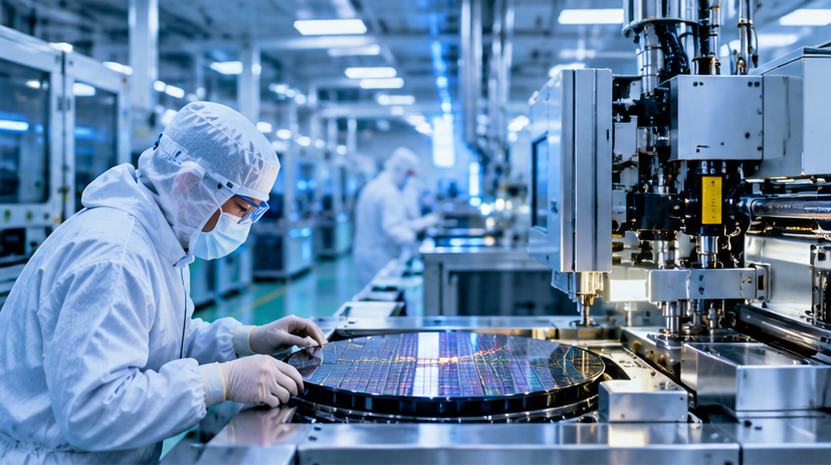
That bottleneck matters because a chip is only useful when the entire production chain can deliver it. Wafer fabrication, packaging, testing, memory, substrates, power systems and cooling all have to work together. A shortage in one stage can delay the delivery of complete AI servers.
Taiwan: A Strategic Centre of Advanced Chip Manufacturing
Taiwan occupies a central position in the production of leading-edge semiconductors. Its foundry ecosystem manufactures chips designed by companies around the world. This specialisation allows technology firms to focus on chip design while relying on highly advanced manufacturing partners.
Reuters reported in October that Taiwan Semiconductor Manufacturing Company (TSMC) recorded a sixth consecutive quarter of record profit, supported by AI demand. The company nevertheless described its planning for 2027 as prudent, citing uncertainty in the wider economy and challenges in consumer-facing markets.
This combination captures the industry’s current position: strong AI-related demand can coexist with caution about the broader business cycle. Advanced chip capacity is expensive, takes years to build and must be matched to customer demand that can change over time.
South Korea: Memory Chips and High-Bandwidth Computing
South Korea is another essential part of the AI hardware ecosystem. Companies such as Samsung Electronics and SK Hynix are major suppliers of memory chips. AI accelerators need fast memory to move large volumes of data efficiently, making high-bandwidth memory an increasingly important component.
When demand for advanced memory increases, suppliers may benefit from stronger prices and higher utilisation. However, semiconductor markets are cyclical. Companies can invest heavily during periods of shortages, only to face excess capacity if demand slows or competing suppliers expand production faster than expected.
South Korea’s opportunity therefore depends on technology leadership, production efficiency and the ability to maintain customer relationships through changing market conditions. The industry also has to manage export restrictions, geopolitical uncertainty and competition from new suppliers.
Japan and the Wider Asian Supply Chain
The semiconductor industry is not made up only of chip designers and wafer factories. Japanese firms are important in materials, chemicals, precision components and equipment used in chip production. Other economies across Asia contribute substrates, packaging, testing, electronics assembly and logistics.
These specialised links make the regional supply chain productive, but also interdependent. A disruption in materials, shipping, energy or specialised machinery can affect factories in several countries. Building resilience requires more than moving one factory: companies need qualified suppliers, technical expertise, infrastructure and reliable access to utilities.

The Investment Question: Can AI Spending Deliver Profits?
Technology companies are committing enormous sums to data centres, processors, networking and electricity infrastructure. These investments may create new services and productivity gains, but they also raise questions about returns. Building capacity is not the same as earning a return on that capacity.
On October 30, Reuters reported that Asian chip supply-chain companies continued to describe AI demand as strong, while investors remained concerned about whether massive infrastructure spending would generate adequate returns. That tension is central to the market outlook.
Investors need to distinguish between companies selling essential equipment today and businesses that may only earn returns after years of AI adoption. Revenue growth, operating margins, customer concentration, capital expenditure, cash flow and debt levels all matter. A compelling technology trend does not automatically make every related stock attractively valued.
Market volatility is a reminder that expectations can become stretched. On November 11, Reuters reported that foreign investors had withdrawn a net $49.77 billion from equities across seven Asian markets in October, amid concerns about AI infrastructure spending, cash burn and profitability. The report also noted additional outflows in November. This does not prove that AI demand has collapsed; it shows that financial markets are reassessing the risks and price paid for future growth.
Geopolitics and the Risk of a Fragmented Chip Market
Semiconductors have become strategic assets because they support communications, transport, healthcare, defence, industrial automation and AI. Governments increasingly view access to advanced chips and manufacturing technology as a matter of economic and national security.
Export controls, investment screening, industrial subsidies and local-content policies can influence where companies build factories and which customers they can serve. Such policies may improve supply resilience in some areas, but they can also increase costs, duplicate capacity and create uncertainty for cross-border businesses.
For companies, the challenge is to build supply chains that comply with regulations while remaining efficient. For governments, the challenge is to protect legitimate security interests without undermining the open research, trade and investment networks that helped the industry develop.

What Does the Semiconductor Boom Mean for ASEAN?
ASEAN economies have an opportunity to participate in the semiconductor value chain. Malaysia has established strengths in assembly, testing and packaging. Singapore plays an important role in semiconductor manufacturing, equipment, research and regional headquarters. Vietnam, Thailand, the Philippines and Indonesia also have opportunities to attract investment in electronics, components, testing, design services and supporting industries.
However, attracting a factory is only the first step. Semiconductor operations require reliable electricity, clean water, logistics, skilled technicians, engineering education, intellectual-property protection and predictable regulation. Governments that invest in these foundations are more likely to attract higher-value activities rather than compete only on low labour costs.
Indonesia can strengthen its position by developing technical skills, improving industrial infrastructure and building links between universities, local suppliers and international manufacturers. It should identify realistic niches where domestic capabilities can grow, rather than assume that every stage of advanced chip production can be established quickly.
Environmental and Energy Challenges
Chip fabrication and AI data centres consume significant electricity and require sophisticated cooling systems. Semiconductor manufacturing also depends on high-quality water and tightly controlled industrial processes. As capacity expands, energy security and environmental performance become economic competitiveness issues.
Countries seeking semiconductor investment need to plan for power generation, grid reliability, water management and responsible waste treatment. Companies face pressure to improve energy efficiency and report the environmental impact of their operations. If infrastructure cannot keep pace, energy constraints may become a bottleneck just as important as chipmaking equipment.
What Businesses and Policymakers Should Watch
Several indicators can help distinguish durable growth from an overheated investment cycle:
- End-market demand: whether AI services are being adopted by paying customers beyond a small group of large technology firms.
- Chip and memory orders: whether demand is broad-based and supported by actual deliveries.
- Capital expenditure and cash flow: whether infrastructure spending produces sustainable operating returns.
- Advanced packaging capacity: whether bottlenecks ease as manufacturers expand production.
- Power and data-centre capacity: whether electricity, cooling and grid investment can support new facilities.
- Trade and export rules: whether new restrictions change access to markets, equipment or customers.
- Market valuations: whether share prices reflect realistic assumptions about future profits and risk.
Conclusion: Asia’s Chip Advantage Is an Opportunity, Not a Guarantee
Asia’s semiconductor ecosystem is central to the expansion of artificial intelligence. Taiwan’s advanced foundries, South Korea’s memory producers, Japan’s materials and equipment suppliers, and ASEAN’s growing electronics industries all contribute to a complex regional network.
AI demand is creating genuine opportunities for manufacturers, workers and economies. Yet the recent reassessment by investors highlights the difference between technological progress and financial returns. Heavy spending, high valuations, geopolitical tensions, energy constraints and supply-chain bottlenecks can all limit the benefits.
The countries and companies most likely to succeed will be those that combine technical capability with disciplined investment, skilled workforces, reliable infrastructure and resilient international partnerships. The AI semiconductor boom may reshape the global economy, but its long-term winners will be determined by execution rather than enthusiasm alone.
Next Article :https://addmysponsor.com/ai-investment-boom-big-tech-spending-global-economic-risk/