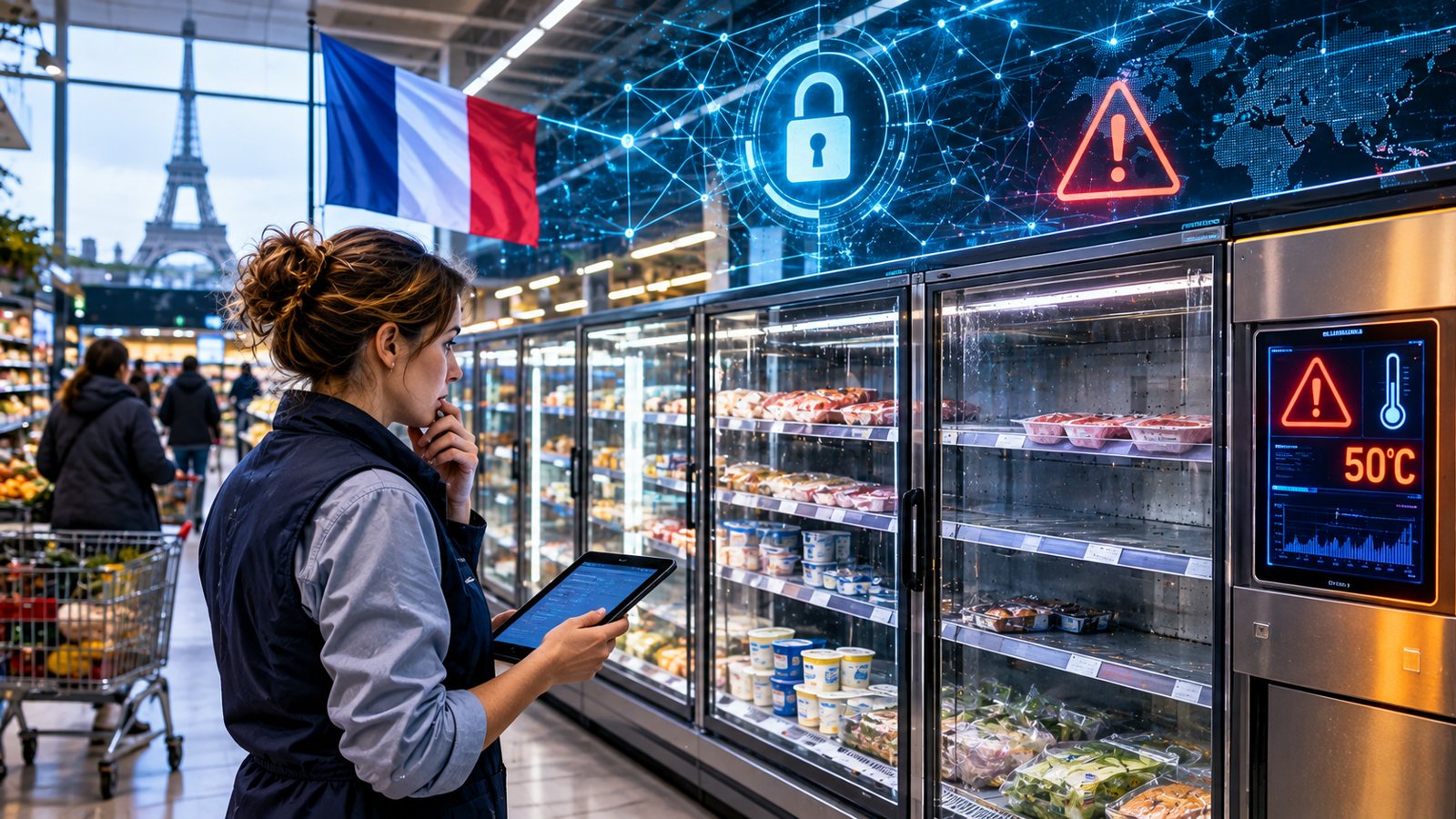
Cyberattack on French Supermarkets Highlights Economic Risks for Food Supply Chains
A reported cyberattack affecting supermarket refrigeration systems in France has drawn attention to the economic risks created when digital systems control essential physical infrastructure. The incident illustrates how a disruption that begins in connected equipment can lead to spoiled inventory, operational costs and pressure across food supply chains.
A Digital Disruption With Physical Consequences
Media reports in October 2026 described cyber-related disruptions involving refrigeration systems at French supermarkets. In affected locations, problems with temperature-control equipment reportedly forced retailers to inspect cold-storage units and remove potentially unsafe products from sale. Authorities were reported to be investigating the incident.
The precise number of affected stores, the total value of discarded products and the identity or motive of those responsible should be treated as unconfirmed unless established by official findings or company disclosures. Early reporting can change as investigations progress.
Why the Incident Matters for the French Economy
1. Direct losses for retailers
When refrigeration fails, supermarkets may need to discard fresh and frozen goods to protect consumers. This can create immediate inventory losses, alongside inspection, repair, cleaning, staffing and restocking expenses. The final financial impact depends on the duration and geographic scope of the disruption.
2. Pressure on suppliers and logistics
Replacing affected products requires new deliveries from farms, food processors, wholesalers and distribution centres. Sudden changes to orders can complicate transport schedules and warehouse planning. Smaller suppliers may be particularly exposed to short-notice cancellations or rescheduling.
3. Food waste and lost resources
Discarded food represents more than lost retail revenue. It also wastes the agricultural inputs, energy, water, packaging, transport and labour used to produce and deliver those goods. Reliable cold-chain systems therefore have economic as well as food-safety value.
4. Insurance and business continuity
Retailers may need to examine whether their insurance policies cover losses caused by compromised operational technology. They may also review supplier contracts, incident-response plans and procedures for safely operating stores when connected equipment becomes unavailable.
Why Refrigeration Systems Need Cybersecurity
Modern refrigeration equipment can use network-connected controllers and remote monitoring to improve efficiency and help staff detect faults. However, unsupported software, exposed remote-access services and weak authentication can increase the risk of unauthorised access.
Businesses can reduce exposure by updating supported software, replacing obsolete controllers, limiting remote access, using multi-factor authentication where available, separating operational technology from ordinary office networks, monitoring unusual temperature changes and testing manual recovery procedures.
A Wider Lesson for European Retail
Supermarkets connect food producers, manufacturers, logistics providers and consumers. A failure in refrigeration can therefore affect more than one retailer: it can disrupt purchasing, distribution and inventory planning across a wider network. The scale of any knock-on effect must be measured rather than assumed.
The broader lesson is that cybersecurity is part of operational risk management. Protecting connected machinery is increasingly important for businesses whose products depend on controlled physical conditions, from food storage to pharmaceuticals and industrial production.
What to Watch Next
The economic picture will become clearer as retailers and investigators establish the number of affected locations, the value of discarded stock, repair costs and any insurance recoveries. Official findings may also clarify how the systems were accessed and what security measures should change.
For France and the wider European retail sector, the incident is a reminder that resilient supply chains require both secure digital networks and reliable physical infrastructure.



One Comment
Comments are closed.